National Blueberry Popover Day
March 10, 2026

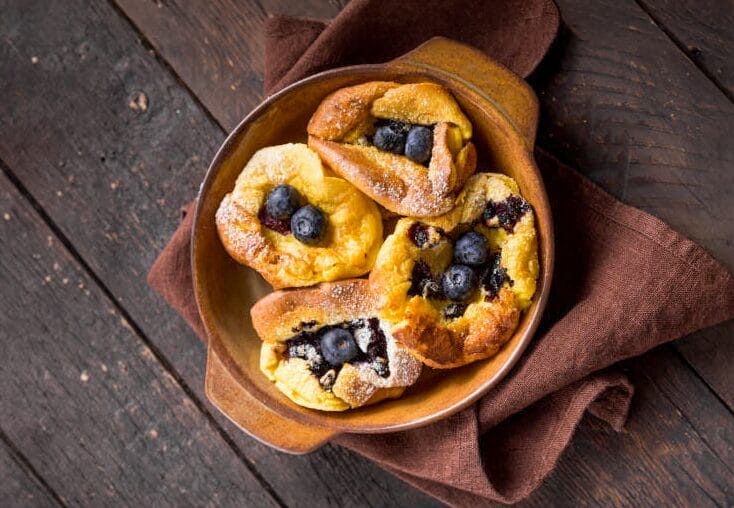
National Blueberry Popover Day celebrates a baked good rooted in steam-leavened batter technique and fruit agriculture. A popover is a light, hollow roll created by baking a thin egg-based batter in a hot oven, allowing steam to expand rapidly and form an airy interior. National Blueberry Popover Day highlights the fusion of this technique with blueberries, a fruit deeply tied to North American agriculture.
Popover batter resembles that of Yorkshire pudding, relying on eggs, milk, and flour. When exposed to high heat, water in the batter converts to steam, causing expansion. The result is a crisp exterior and a hollow interior suitable for sweet or savory applications. This steam-based leavening predates chemical baking powders and demonstrates how physics shaped early baking.
The ingredient microhistory central to this observance is the blueberry. Native to North America, blueberries were harvested by Indigenous peoples long before commercial cultivation. Modern highbush blueberry farming developed in the early twentieth century through agricultural research and selective breeding, transforming blueberries into a major commercial crop.
Migration and trade influenced the blueberry’s rise in baked goods. As refrigeration improved and berry transport stabilized, fresh blueberries became widely available beyond harvest regions. Frozen blueberries further expanded seasonal flexibility, allowing incorporation into batters year-round.
Technological inflection points include advances in oven design and metal bakeware. Popover pans with deep wells allow vertical rise and uniform heat distribution. Reliable oven temperatures are crucial because insufficient heat prevents proper steam expansion.
National Blueberry Popover Day reflects the interplay between fruit cultivation and baking science, uniting agricultural development with thermal physics.
National Blueberry Popover Day highlights blueberries as a commercial agricultural success story. Once foraged, blueberries are now cultivated extensively in regions such as Maine, Michigan, and the Pacific Northwest. Their growth requires acidic soil and careful management, making them regionally specific crops.
Sensory anthropology explains the pairing. Blueberries provide bursts of acidity and sweetness that contrast with the neutral, egg-forward popover batter. As blueberries heat, their skins soften and juices release, creating pockets of flavor inside the airy structure.
Economically, blueberry integration into baked goods adds value to fruit harvests. Surplus berries can be frozen, processed, or incorporated into products like popovers, muffins, and pies. This diversification stabilizes farmer income and reduces waste.
Regional comparisons show variation in presentation. Some traditions dust popovers with powdered sugar for sweetness. Others incorporate lemon zest to accentuate berry brightness. In certain regions, savory popovers omit fruit entirely, underscoring the flexibility of the technique.
A misconception worth correcting is that popovers require chemical leavening. In reality, steam is the primary rising force. Understanding this technique clarifies why oven temperature and batter composition are critical.
Economic resilience appears in the adaptability of both ingredients. Popovers require simple pantry staples, while blueberries can be fresh or frozen. This combination allows households and bakeries to adjust according to seasonal pricing.
18th century: Yorkshire pudding and similar steam-leavened batters establish early popover-like techniques.
19th century: Baking equipment improves, allowing more consistent oven temperatures.
Early 20th century: Agricultural research supports domesticated highbush blueberry cultivation.
Mid 20th century: Refrigeration and freezing expand blueberry distribution beyond harvest regions.
Late 20th century: Specialty bakeware and standardized recipes popularize popovers in home kitchens.
21st century: Farm-to-table movements highlight regional berry sourcing and seasonal baking.
Present day: Blueberry popovers combine agricultural heritage with baking science in modern culinary practice.
National Blueberry Popover Day matters because it connects two forms of innovation: agricultural domestication and steam-based baking. The blueberry’s journey from wild forage to cultivated crop parallels the refinement of oven technology that enables popover structure.
Modern supply chains allow blueberries to be available fresh or frozen year-round, yet pricing and crop yields remain sensitive to weather patterns. Climate variability directly influences harvest volume.
Sensory anthropology reinforces the appeal of contrast between crisp shell and juicy berry interior. The interplay of texture and acidity creates balance without heavy frosting or decoration.
Misconceptions about popover complexity can be corrected by recognizing that success depends more on heat management than elaborate ingredients.
Economic resilience remains evident in the flexibility of ingredients, allowing adaptation across price fluctuations and seasons.
National Blueberry Popover Day matters because it honors a union of berry agriculture and thermal baking science, demonstrating how simple ingredients become structurally impressive foods.


